

2026 Guide: How to Set and Fine-Tune CG on RC Airplanes
Getting your RC airplane's center of gravity (CG) right is one of the most important parts of a successful setup. It affects stability, elevator response, and how the airplane behaves during upright, inverted, and 3D flight.
At Twisted Hobbys, we provide a recommended CG for each model as a starting point. That recommendation comes from flight testing, but it isn't necessarily the final balance every pilot will prefer. Some pilots enjoy a slightly nose-heavy airplane for stability and precision, while others prefer a more neutral setup for consistent upright and inverted flight. Experienced 3D pilots sometimes prefer a more rearward CG for certain maneuvers.
The goal is to start safely, make small adjustments, and find the balance that feels right to you.
1. Build It Straight and Start With the Recommended Equipment
Before fine-tuning CG, check the fundamentals. A straight airframe, properly aligned wing and stabilizer, centered control surfaces, and a correctly installed motor make the aircraft easier to trim and evaluate. The recommended power system, battery, and servos also help keep the airplane near its intended all-up weight (AUW).
Even lightweight profile EPP models can respond noticeably to small differences in assembly and alignment. If a model behaves strangely, don't immediately assume the CG is wrong.
2. Set the Initial CG Before the Maiden Flight
Use the CG measurement in the latest build manual for your exact model. Depending on the aircraft, the reference may be measured from the nose or from the wing's leading edge. Do not transfer measurements between different models or sizes.
- Install the battery and all equipment in the normal flight configuration.
- Measure and mark the CG location shown in the model's manual.
- Support the airplane at that position using your fingertips or an appropriate CG balance tool.
- Move the battery slightly forward or backward until the model balances at the starting point, then secure it carefully.
Battery forward: more nose-heavy. Battery rearward: more tail-heavy. A slightly forward CG is generally a better maiden-flight starting point than an excessively rearward one.
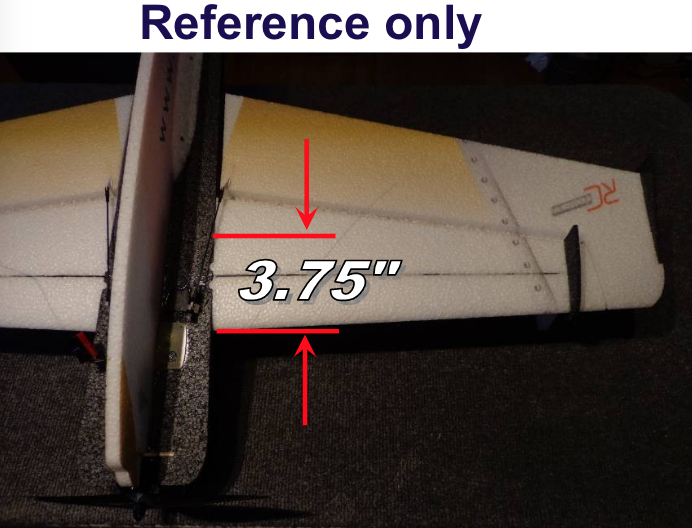
Find the current instructions for your aircraft in our Product Manuals & Build Guides.
3. Fine-Tune CG With Upright and Inverted Flight
Once the airplane is safely flying, choose a calm day, plenty of clear airspace, and a comfortable cruising speed. On many of our 3D models, roughly three-quarter throttle can be a useful reference, but maintaining similar airspeed between tests matters more than using one exact throttle setting.
First, fly upright. Trim the airplane to fly straight and level at the chosen speed. Confirm aileron and rudder trim are reasonable and the model isn't fighting a mechanical alignment issue.
Next, fly inverted. At a similar airspeed, observe the amount of down-elevator input needed to hold level flight. A more forward CG generally calls for more down elevator when inverted. A rearward CG generally reduces that correction but can also make the airplane more pitch-sensitive.
Move the battery in small increments, secure it, and repeat the test. The goal isn't necessarily zero elevator input inverted. What matters is predictable handling that fits your own flying style. Most models will still need some inverted correction because their aerodynamics aren't perfectly symmetrical.
4. Is It Really CG, or Something Else?
Here's a trick I like to use when dialing in my own airplanes: a controlled power-off descending test. At a safe altitude, reduce the throttle fully and observe whether the airplane naturally pitches toward its canopy or belly during a steady descent. That can help reveal a persistent pitching tendency without the influence of powered thrust.
An important distinction: a power-off descent does not directly measure motor thrust angle, because the motor is producing little or no thrust. It can help you investigate airframe alignment, trim, and aerodynamic behavior. To investigate thrust-angle effects, also observe whether the airplane changes pitch consistently as you change power during otherwise stable flight, while allowing for normal changes in airspeed.
On profile airplanes, even small construction or thrust-angle differences can create effects that pilots mistakenly try to fix by moving the battery. Before shimming a motor mount, inspect the installation, compare powered and power-off behavior, and make sure the CG is already in a reasonable range. Small pitching changes can also be normal for a model's airframe design.
5. Don't Forget Lateral Balance
CG is typically discussed from nose to tail, but left-to-right balance matters too. A battery, ESC, or receiver installed well off center can make one wing heavier than the other.
Whenever practical, locate equipment close to the centerline. Some pilots create a carefully fitted battery slot through the horizontal fuselage so the battery sits more centrally. This is optional and should only be done where the model's structure and build instructions allow it.
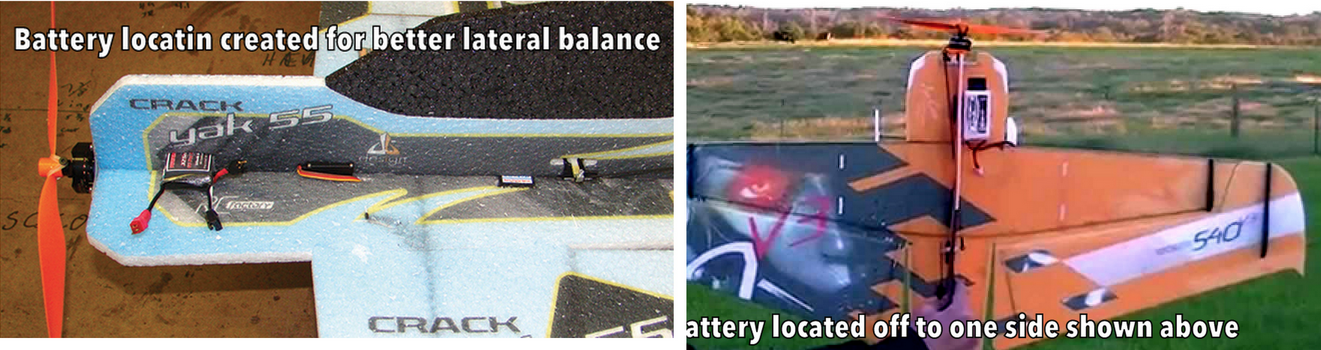
For an approximate lateral balance check, with the propulsion system disabled for safety, carefully support the aircraft along its longitudinal centerline using safe structural points. If one wing consistently drops, check equipment placement before adding unnecessary weight.
6. Quick CG Setup Checklist
- Build the airframe straight and confirm the controls and motor mounting are correct.
- Use the latest, model-specific manual for the starting CG measurement.
- Fit and securely mount the flight battery; balance the complete airplane.
- Maiden the model at the recommended CG in safe conditions.
- Trim upright flight and evaluate inverted flight at similar airspeeds.
- Make only small battery-position changes, one adjustment at a time.
- If pitching behavior persists, check trim, alignment, power-related effects, and CG instead of assuming one cause.
- Check lateral balance and mark the battery position once you're happy.
Final Thoughts
There is a reason we call our CG measurements recommended starting points. One pilot might prefer a slightly forward balance for a smoother, more stable airplane; another may prefer a more neutral feel for precision and 3D maneuvers. Neither preference is automatically wrong, provided the airplane remains within a safe, controllable range.
Start with the manual, fly it, evaluate its behavior, and fine-tune the setup to your liking. Sometimes what feels like a CG issue is really a small alignment or trim difference, so take time to look at the whole airplane.
Enjoy the flying!
Brad
Twisted Hobbys
Designed and Proven by Twisted Hobbys
Recent Posts
-

2026 Guide: How to Set and Fine-Tune CG on RC Airplanes
Getting your RC airplane's center of gravity (CG) right is one of the most important parts of a s …Oct 27th 2026 -
Crack Yak-55 XL first build!
What do you get when you feed the popular Crack Yak after midnight? The all new Crack Yak 55 XL with …Mar 22nd 2025 -
Crack Pitts XL Blog
Chris Doerr dives into this Crack Pitts XL model by Twisted Hobbys.Mar 22nd 2025